
 Over the past 12–18 months, I’ve seen a noticeable shift in buyer behavior across Warren County — particularly from developers and well-capitalized land investors. Much of this activity is happening before major announcements, rezonings, or public-facing development plans ever surface.
For landowners, this matters. Timing — not just acreage — is increasingly driving value. Below is what’s actually happening on the ground, and why certain Warren County parcels are drawing quiet but serious interest. Development Pressure Is Expanding Beyond Mason: Mason remains the headline market, but developers are increasingly looking just outside the obvious growth nodes:
Infrastructure Comes Before Headlines: Most land value appreciation tied to development doesn’t occur after infrastructure improvements — it begins during the planning phase. Developers closely track:
Buyer Profiles Have Changed: Today’s active buyers are not casual speculators. They are:
Why Some Landowners Miss the Window: A common mistake I see is landowners waiting for rezoning or public announcements before exploring value. By that point:
What This Means If You Own Land in Warren County: If you own land — especially near growth corridors or expanding municipalities — your property may already be on a developer’s radar, even if no one has contacted you yet. Understanding the following can materially affect both price and terms:
Not all land is meant to be sold — but landowners deserve to understand what their property is worth in today’s market, not based on outdated assumptions or automated estimates. If you’d like a confidential, no-obligation review of your land’s current market position — including buyer demand and development potential — I’m happy to provide one based on real activity in Warren County. Timing matters. Information matters more.
0 Comments
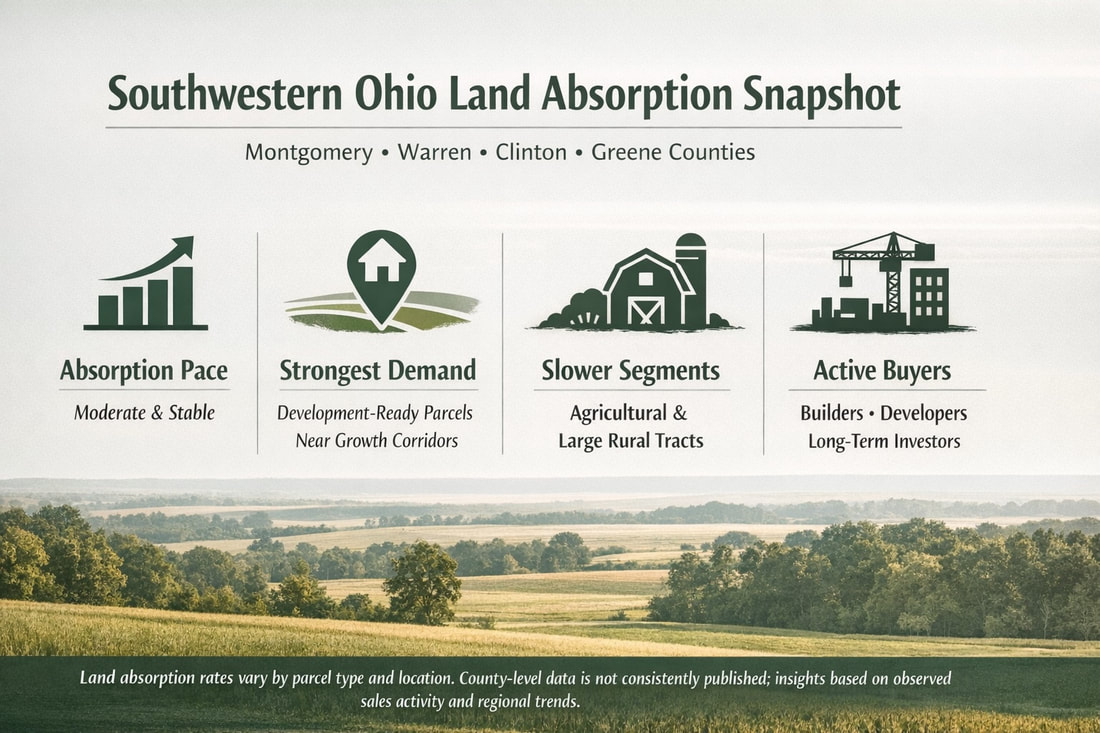 The land market in Southwestern Ohio—including Montgomery, Warren, Clinton, and Greene Counties—remains active but highly segmented. While land does not trade with the same velocity as residential real estate, current absorption trends provide useful insight into demand, pricing power, and timing for sellers and investors.
What Is Land Absorption Rate? Absorption rate measures how quickly available land inventory is being purchased. It is typically expressed as the percentage of active listings that sell within a given period or as months of supply based on current sales activity. Higher absorption indicates stronger demand relative to supply. 📌 Market Snapshot: Southwestern Ohio Land • Absorption Pace: Moderate and stable • Strongest Demand: Development-ready parcels near growth corridors • Slower Segments: Large rural, agricultural, and recreational tracts • Buyer Profile: Builders, developers, and long-term investors • Market Balance: Comparable Ohio counties show low-to-mid-teen absorption rates, generally considered balanced for land markets Current Market Conditions Unlike residential real estate, county-level land absorption rates are not consistently published in public reports or MLS summaries. However, transaction data, days-on-market trends, and development activity across Southwestern Ohio indicate a steady, selective absorption environment.
What This Means for Owners and Buyers
For landowners seeking accurate pricing and strategic positioning, Jared Williams brings specialized expertise in Southwestern Ohio land markets. |
AuthorJared M. Williams is a licensed real estate broker who specializes in land and farm sales throughout Ohio. Archives
August 2026
Categories |
 RSS Feed
